
Frequently Asked Questions
Questions are part of the process.
Orthodontic treatment involves decisions about timing, treatment options, cost, insurance, and what to expect along the way. We've answered some of the questions patients ask us most often.
Treatment & Care
Common treatment questions.
Do I need a referral?
No. You can schedule a consultation directly with our office; no referral is required.
Before treatment begins, the patient is responsible for having a dental exam and cleaning within the last six months and having no cavities or gum disease.
What age should I bring my child to see an orthodontist?
We feel prevention is often the best medicine. All children age 6 and up should be evaluated by an orthodontist. This is because some kids may benefit from growth modification or assistance with permanent tooth eruption.
In special cases, we will see children younger than 6 years old.
What are the typical steps of orthodontic treatment?
Initial consultation
Treatment starts with an initial consultation. We then provide a preliminary plan and an estimate of treatment time.
Financial discussion
Our office manager will then discuss the financial portion with you.
Records and treatment planning
Should you decide to move forward with treatment, we then take records (digital scans, photos, and X-rays). Afterwards, we evaluate the records, and make any necessary adjustments to the treatment plan.

Your individualized next step
The next step depends on your individualized plan. Our goal is to show you a simulation of your expected treatment outcome as soon as possible. Occasionally, some treatment, such as expansion, is needed before we can show you a realistic treatment outcome.
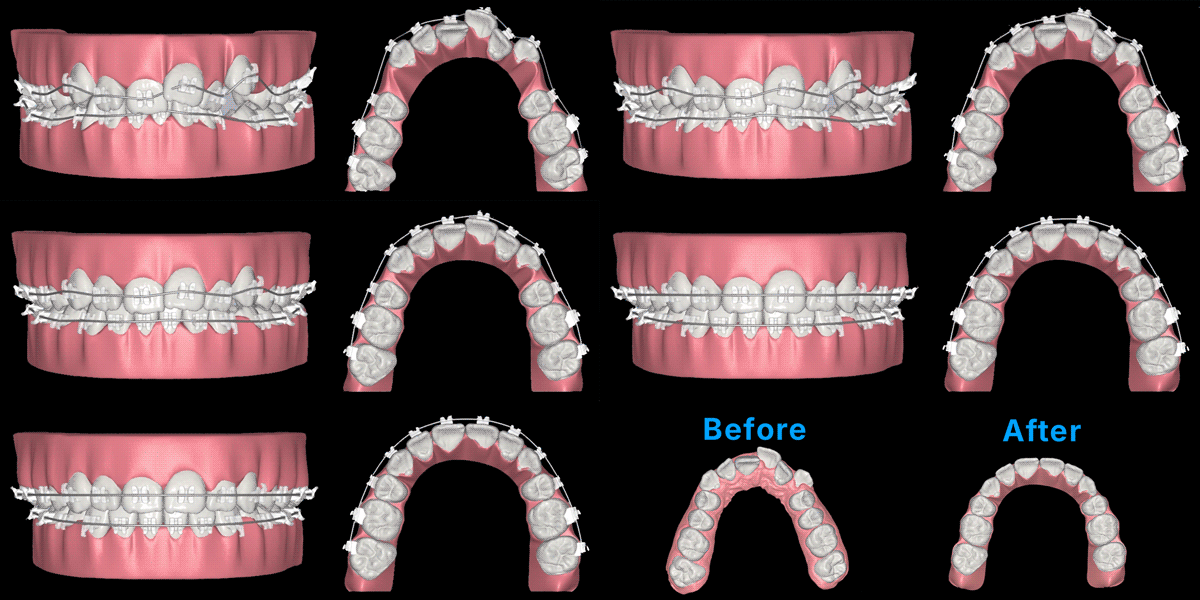
What treatment options are available?
We offer metal or clear braces, aligners, retainers, occlusal guards, and additional treatments based on your needs, including TMJ-related care, sleep health, and airway-focused solutions.
Every plan is customized based on your goals.
Braces vs aligners: which is better?
Both braces and aligners can be effective treatment options, but they work differently. Braces are more predictable and work continuously with less patient involvement.
Aligners are removable, easier to clean and more discreet, but take longer and require constant attention to stay on track.
The best option depends on your specific needs, lifestyle, and goals. We'll walk you through the treatment options during your consultation.
Is orthodontic treatment painful?
We always try to make treatment as comfortable as possible. Some discomfort is unavoidable.
Typically, patients experience the most discomfort at the start of treatment when appliances are placed, such as braces or expanders.
After that, there is usually mild discomfort for 1-3 days after each adjustment.
Should I still see my dentist while I'm in orthodontic treatment?
Yes. Regular dental visits are essential during orthodontic treatment. You need to see your dentist every 3 to 6 months to monitor for cavities and gum health, especially while in orthodontic treatment.
How long does orthodontic treatment take?
Treatment time varies depending on the complexity of your case, but many patients complete treatment in 16 to 24 months.
Cost & Insurance
Common financial questions.
Do you accept dental insurance?
We accept most dental insurance plans and file claims on your behalf.
Please note that Medicaid is not accepted.
Will The Orthodontist bill my dental insurance for me?
Yes, our team is happy to help you get the most out of your insurance coverage. We submit insurance claims for your convenience.
Do you offer financing?
Yes. We offer flexible financing options through in-house payment plans to make treatment more affordable. We provide increasing discounts for larger down payments.
Since every case is different, we'll review exact costs and payment options at your consultation.
How is orthodontic insurance coverage different from general dental insurance coverage?
Unlike general dental coverage that often renews annually, many orthodontic insurance benefits have a lifetime maximum per patient. Once that lifetime maximum has been paid, the plan generally will not provide additional orthodontic benefits for that patient, regardless of whether treatment is provided in- or out-of-network.
That's why we encourage patients to consider quality of care and their experience with the orthodontist in addition to insurance status. After all, they'll be the ones creating your forever smile!
What does it mean to be an out-of-network provider?
Out-of-network means that the healthcare provider does not have a contract with your insurance company.
With many orthodontic insurance plans, benefits are still available when treatment is provided by an out-of-network orthodontist. Whether there is a difference in coverage depends on the specific plan.
Signing a contract to be in-network can require a healthcare provider to adjust its workflow to accommodate the systems and requirements of the insurance company.
If The Orthodontist is not in-network with my dental insurance, can I still get coverage?
Absolutely. Choosing an out-of-network orthodontist does not necessarily mean you lose your orthodontic benefits. Patients successfully use orthodontic benefits with out-of-network providers every day. What matters most is getting care from a provider you trust. With patience, we can help you understand your coverage and work to maximize the benefits available under your plan.
With many plans, orthodontic benefits are available both in- and out-of-network, although the amount and terms of coverage depend on your specific plan.
If you're not in-network with my dental insurance, will my coverage be lower?
For approximately 90% of the dental insurance plans we see, the lifetime orthodontic maximum is $1,500–$2,000 per person, regardless of network status.
However, plans vary. Some plans provide different benefits for in-network and out-of-network treatment, so we recommend reviewing your specific orthodontic benefits.
How much does dental insurance typically cover for orthodontics?
The simple answer is that with approximately 90% of the dental insurance plans we see, there is a lifetime orthodontic maximum of $1,500 to $2,000 per patient. Once that lifetime benefit has been used, it generally is not available again for treatment with another orthodontist.
The more detailed answer is that many dental plans cover orthodontic treatment at 50% of the total treatment cost, up to the plan's lifetime maximum.
For example, if braces cost $6,000 and your plan covers 50% with a $2,000 lifetime maximum, the calculated 50% benefit would be $3,000, but the lifetime maximum limits the insurance payment to $2,000. The patient would be responsible for the remaining $4,000.
Your actual benefits depend on your specific insurance plan.
At what point during orthodontic treatment does dental insurance help pay?
We cannot submit an orthodontic treatment claim until treatment has begun. Insurance companies typically provide a larger initial payment followed by smaller periodic payments until the available benefit is reached.
Some dental insurance plans pay the entire available amount within the first 1–3 months of treatment.
Why is The Orthodontist out-of-network?
We want to provide the same approach to care regardless of which insurance company a patient uses, or whether they have insurance at all.
In-network contracts can include requirements that affect how a healthcare provider works with the insurance company. We don't want our treatment approach to be restricted by the varying and changing requirements of different insurance plans.
Remaining out-of-network allows our doctor to approach treatment consistently rather than changing how we work based on whether a patient has Delta Dental, Aetna, another insurance plan, or no insurance.
Why choose an out-of-network orthodontist?
Choosing an out-of-network orthodontist can give patients the option to select a provider based on the treatment approach, experience, technology, and office that they prefer—not solely on an insurance network.
Our decision to remain out-of-network allows us to plan and provide treatment without structuring our approach around the requirements of different insurance contracts. Orthodontic benefits may still be available out-of-network, depending on your specific plan.
Still Have Questions?
Some questions are easier to answer in person.
Treatment recommendations, costs, and insurance benefits vary from patient to patient. A consultation gives us a chance to discuss what applies to you.